

Chinese Tea and Culture is Famous around the World, Tea's History, Top Chinese Tea Types and Tips on How to drink Tea Effectively.
Tea is an important part of Chinese tradition. As Chinese society developed and progressed, tea production has played a role in driving economic development while tea consumption has remained a practice of daily life.
The practice of tea culture can bring the spirit and wisdom of human beings to a higher orbit. Tea has an extremely close relationship to Chinese culture, and its study covers a wide field and has very rich content. It not only embodies the spirit of civilization, but also the spirit of ideological form. There can be no doubt that it has been beneficial in enhancing people's social accomplishments and appreciation of art.
History of Chinese Tea
The history of Chinese tea is a long and gradual story of refinement. Generations of growers and producers have perfected the Chinese way of manufacturing tea, and its many unique regional variations.
 Picking Tea Leaves
The original idea is credited to the legendary Emperor Shennong, who is said to have lived 5 000 years ago. His far-sighted edicts required, among other things, that all drinking water be boiled as a hygienic precaution. A story goes that, one summer day, while visiting a distant part of his realm, he and the court stopped to rest. In accordance with his ruling, the servants began to boil water for the court to drink. Dried leaves from a nearby bush fell into the boiling water, and a brown substance was infused into the water. As a scientist, the Emperor was interested in the new liquid, drank some, and found it very refreshing. And so, according to legend, tea was created in 2737 BC.
Chinese Tea Types
The main varieties of Chinese tea are classified as green tea, black tea, Oolong tea, white tea, yellow tea, and dark tea. Read more on Chinese tea types.
Chinese Tea Culture
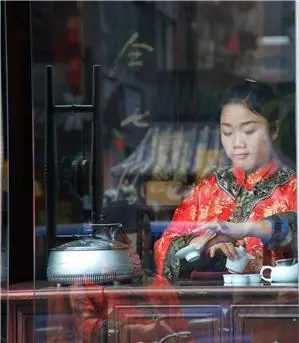 Tea Performance
Drinking tea:Tea is taken as a beverage to quench thirst.
Tasting tea: The quality of the tea is judged by the color, fragrance and flavor of the tea, the water quality and even the tea set. When tasting tea, the taster should be able to savor the tea thoroughly.
Tea art: While drinking attention is paid to environment, atmosphere, music, infusing techniques and interpersonal relationships
From https://www.chinahighlights.com/travelguide/chinese-tea/
